| Jobsite
Management / Worker & Environment Safety
 Construction
and surface preparation projects frequently produce airborne
contaminants including silica dust, grinding debris, fumes, and
odors. Proper job-site ventilation is essential for
maintaining safe working conditions and controlling airborne
dust migration. Industrial ventilation blowers paired with
ducting and containment accessories provide an effective
solution for controlling airborne particulates in both temporary
containment areas and open job sites. Construction
and surface preparation projects frequently produce airborne
contaminants including silica dust, grinding debris, fumes, and
odors. Proper job-site ventilation is essential for
maintaining safe working conditions and controlling airborne
dust migration. Industrial ventilation blowers paired with
ducting and containment accessories provide an effective
solution for controlling airborne particulates in both temporary
containment areas and open job sites.
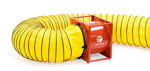
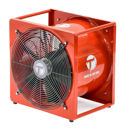
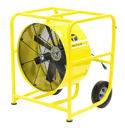
The ventilation blower system
provides up to 15,668 CFM of airflow and is commonly used for
negative pressure ventilation and confined space air
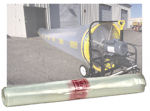
movement. When combined with flexible ducting and dust
socks, the system allows contractors to direct contaminated air
away from the work area while maintaining proper airflow
circulation. This approach is widely used during concrete
grinding, epoxy floor coating installation, demolition projects,
and interior construction work.
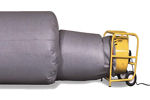
Negative pressure ventilation
works by drawing contaminated air through a defined airflow
path. The blower is positioned near the dust generation
area and connected to ducting or filtration accessories.
As air is pulled through the system, airborne particles are
either exhausted outside the work zone or captured within a dust
containment sock. This prevents dust migration into
adjacent spaces and significantly improves job-site air quality.
Ventilation systems like these
are particularly valuable when dust shrouds and vacuum systems
alone cannot manage airborne contaminants. High-CFM air
movement allows contractors to control large areas quickly and
efficiently while maintaining compliance with safety guidelines
related to airborne dust exposure.
Complete ventilation kits simplify
equipment selection by combining compatible components into a
ready-to-use system. This eliminates the need to determine
duct sizes, adapters, and airflow compatibility individually,
saving time during job setup while ensuring optimal performance.
|